
Making the switch from CCFL to LED LCD backlights doesn’t have to be complicated or difficult.
By SCOTT BARNEY
Vice President, Sales & Marketing
Endicott Research Group (ERG) Inc,
www.ergpower.com
As lighting topologies have advanced, backlighting technologies have evolved to keep pace. At one time, cold cathode fluorescent lamps (CCFLs) were the dominant technology for backlighting active matrix thin film transistor (TFT) LCDs, and were powered by DC-AC inverters.
Now, LED backlights have taken over. Their advantages over CCFL have been well documented – higher brightness, longer lifetime, lower power consumption and no mercury, to name a few. Powering these LED backlights, which are usually in the form of rails, strings or LED arrays, has presented many manufacturers and users of display power supplies with an adapt or die scenario. As CCFLs fade away, LED drivers have risen to prominence

Fig 1. CCFL tube BLUs (top) are rapidly giving way to LED strings or rails (bottom) for LCD backlighting.
At present, LED users have a number of options. One is to continue for use CCFLs with DC-AC inverters for the time being.
CCFL still hanging on
CCFLs are not entirely dead yet, and they are still an option for certain “legacy” applications (medical and point-of-sale, e.g.), where a re-design for LED backlighting is not yet necessary or economical. And, although many CCFL and inverter manufacturers are abandoning this technology, there are a few that
continue to support the CCFL industry so that customers still have that option for as long as they need it. CCFLs are not the future but, at present, there is still a demand and a few manufacturers – ERG included – are still selling them to support customers who are still using CCFL.
The majority of LCD users, however, are switching to LED backlights. The optimum scenario here is to make the transition from CCFL to LED as quick, easy and painless as possible while getting the optimum performance from the LED BLUs.
Designing in an LED driver
LED backlights create new challenges for the power supply driving the BLU (backlight unit), challenges that cannot be met by the many single chip ICs available on the market today. Getting optimum performance from LED BLUs requires a full-function power supply, ideally from a company that has experience in power solutions for LCD backlights and understands such issues as:
- What voltage does the device need across it to accurately regulate current? Is there enough voltage across the device remaining to light the LED string and provide proper current regulation?
- What temperature are the LED voltages specified at? Say it is 25º C (approx. 77º F): if you were to take the LED string below 25º C (unlit) and then power the string, the LEDs may not light at all because the LED string voltage is greater.
- Is the power supply designed to account for this voltage change and can it light across the entire normal operating range of temperatures, with no time or expense devoted to designing a boost circuit?
And what about the LED BLU itself? Does it address the challenge of keeping the LEDs cool? Does it conduct heat from the LEDs with enough efficiency to keep the junction temperature at or below the recommended operating temperature, which is critical to preventing overheating and ensuring cool, high-brightness, long-life operation of the LED BLU?
It only makes sense to look for an LED driver manufacturer that designs and manufactures its own magnetic components and offers a wide range of standard and custom product that provides high efficiency power to LED backlights used in LCDs up to 27” diagonal from all major OEMs — with wide range dimming, 12 V input voltage and full brightness and enable control.
Options for making a quick switch to LED
If you are sourcing a driver for an LED backlit LCD, you have a multitude of options, depending on your situation, that can make the switch surprisingly fast and easy.
One option is a development kit available for OEM LED-backlit LCDs that includes everything necessary to get the panel, backlight and driver fully operational. Each kit is designed for a specific OEM LCD and includes the appropriate LED driver card, a flying lead input harness, a controller-to-driver plug-and-play input harness, and a direct mate LED driver-to-LCD interconnect wiring harness (where applicable).
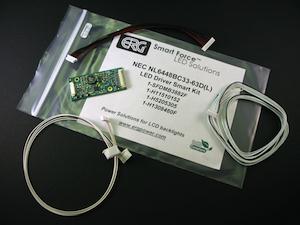
Fig. 2 – Development kits are available for LED-backlit panels in popular industrial sizes from AOU, NEC, Sharp, Kyocera and other major LCD OEMs.
For CCFL designs already in the field, it’s possible to swap an LED rail for the CCFL lamp, or “tube”. LED rails are available on a long, narrow PC board that fits into a metal channel or “rail” that is similar in form factor to the channel into which CCFLs are commonly fitted. These are available as a drop-in replacement for CCFL rails for a number of OEM LCDs and, used in conjunction with LED driver boards that replace the DC-AC inverters, they can provide the simpler and less costly option of replacing the lamps and power sources in an existing LCD rather than re-designing the whole system.
Another option is to integrate an LED Display into an existing design by providing interconnectivity from the existing controller or power supply to the LCD backlight driver. If your current LCD going end of life and the recommended replacement LCD has an LED backlight and a built-in driver – and your current input signals are incompatible with the new requirements — there is an option that can make the LCD upgrade as seamless as possible. The module shown in Fig. 3 uses the system’s existing input power signals and converts the analog dimming signal used for the inverter into a PWM signal for the LED driver. In this way, the system’s existing signals are utilized, powering the LED backlight driver without additional modifications.

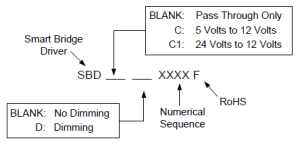
Fig 3. This “Smart Bridge” module uses existing input power signals and converts the analog dimming signal used for the inverter into a PWM signal for the LED driver.
Additional Options
For example, if you need a driver that won’t require hardware redesign, there are drop-in replacements available that offer the same mechanical footprint as DC-AC inverters in the field (ERG’s and those of other inverter manufacturers) with pin-for-pin compatibility. This allows for a fast, easy upgrade to LED backlighting without re-designing or re-tooling the mounting hardware.
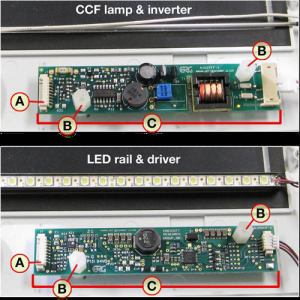
Fig. 4. These drop-in replacement LED driver boards have the same length and width dimensions as their DC-AC inverter counterparts as well as matching input connects and mounting holes.
Conclusion
Whatever your situation, it is always best to power LED BLUs with drivers that provide a regulated DC current source and are designed specifically for OEM LED backlights or LED strings, with wide input voltage range and wide range PWM dimming.